



As Zambia emerges as a regional food basket following a record-breaking 2025 harvest, indigenous agribusiness H.M. Agrovert is playing a pivotal role in connecting smallholder farmers to reliable markets while contributing to the nation’s strategic food reserves.
MKUSHI, ZAMBIA — In the fertile agricultural heartland of Central Province, a Zambian-owned enterprise is transforming the way farmers bring their produce to market. H.M. Agrovert General Dealers Services & Limited, operating from its headquarters in Mkushi’s Natwange Complex, has positioned commodity trading as a cornerstone of its diversified portfolio—with profound implications for local farmers and national food security alike.
The timing couldn’t be more significant. Following the devastating 2023/2024 drought—described as the worst in four decades—Zambia’s agricultural sector has mounted a remarkable recovery. According to the Food and Agriculture Organization (FAO), the country’s 2025 cereal production rebounded to 3.9 million tonnes, more than double the drought-reduced output of 2024 and nearly 20 percent above the five-year average . Maize production alone reached 3.6 million tonnes, matching the record attained in 2017 .
This bumper harvest has transformed Zambia from a grain-deficient nation to a net exporter virtually overnight—and companies like H.M. Agrovert are ensuring the benefits reach the grassroots.
Bridging the Gap Between Harvest and Market
For Zambia’s smallholder farmers, who produce the majority of the nation’s food, accessing reliable markets has historically been the weakest link in the value chain. H.M. Agrovert’s strategic engagement in grain trading directly addresses this challenge.
“Growth through partnerships isn’t just our motto—it’s our operating principle,” explains Hazel Mulikita, Director/Manager of H.M. Agrovert. “When we engage in commodity trading, we’re not just buying grain. We’re providing farmers with certainty—the knowledge that their hard work throughout the season will translate into income that can send children to school, improve homes, and invest in the next planting season.”
The company’s extensive network of outlets across Central Province—including locations in Mkushi, Kapiri Mposhi, Serenje, Chitambo, and Luano—positions it strategically to aggregate produce from farming communities that might otherwise struggle to access competitive markets. This last-mile reach is critical in a country where rural infrastructure remains challenging and transport costs can erode farmer profits.
Aligning with National Food Security Priorities
H.M. Agrovert’s grain trading operations align closely with Zambia’s broader agricultural policy objectives. Following the 2025 harvest, President Hakainde Hichilema directed the Food Reserve Agency (FRA) to double its maize purchase target from 500,000 to one million metric tonnes, citing the need to strengthen national food security and support farmers amid the bumper harvest .
The FRA, established to maintain Zambia’s strategic food reserves, has been working alongside private sector partners to secure national stocks. Agriculture Minister Reuben Mtolo has emphasized that adequate reserves are essential to prevent Zambia from relying on imports during future shortages .
“Private sector participation in grain trading complements the FRA’s strategic role,” notes an agricultural policy analyst. “While the agency builds strategic reserves, private traders like H.M. Agrovert provide immediate offtake, stabilize rural prices, and create competition that benefits farmers.”
Regional Export Opportunities
Beyond domestic markets, H.M. Agrovert’s commodity trading activities position the company to participate in Zambia’s emerging role as a regional food supplier. In August 2025, the Zambian Cabinet approved the export of 500,000 tonnes of surplus maize to other countries—a policy shift aimed at boosting foreign exchange earnings and establishing Zambia as a reliable regional food supplier .
Agriculture Minister Mtolo Phiri stressed that this decision followed careful assessment of national food security needs, with the FRA confirming adequate stocks to meet local consumption even with the export quota .
The regional demand is tangible. In October 2025, Zambia and Malawi finalized a presidential agreement for the export of 200,000 metric tonnes of maize to Malawi, strengthening food security and resilience across borders . Zambian Minister of Finance and National Planning Situmbeko Musokotwane emphasized that this collaboration reflects Zambia’s broader commitment to regional solidarity, stating: “When our neighbors face difficulty, we stand together” .
For H.M. Agrovert, these regional trade flows represent significant opportunities. The company’s transportation division, with its fleet and logistics capability, positions it to participate in cross-border grain movement when opportunities arise.
From Subsistence to Commercial Agriculture
The government’s maize export policy forms part of a wider strategy to transform Zambian agriculture from subsistence production to a commercially competitive industry . This vision resonates deeply with H.M. Agrovert’s business model.
Maxwell Tembo, Director/Manager overseeing operations, explains: “When we buy grain from farmers, we’re not just completing a transaction. We’re signaling that farming can be a viable business. The farmer who sells through H.M. Agrovert today is the commercial farmer of tomorrow, employing more land, more workers, and contributing more to the economy.”
This multiplier effect is well-documented. Research across sub-Saharan Africa consistently shows that reliable market access correlates with increased agricultural investment, technology adoption, and productivity gains. By providing consistent offtake at fair prices, private grain traders create the conditions for this virtuous cycle.
Infrastructure and Logistics: The Backbone of Grain Trading
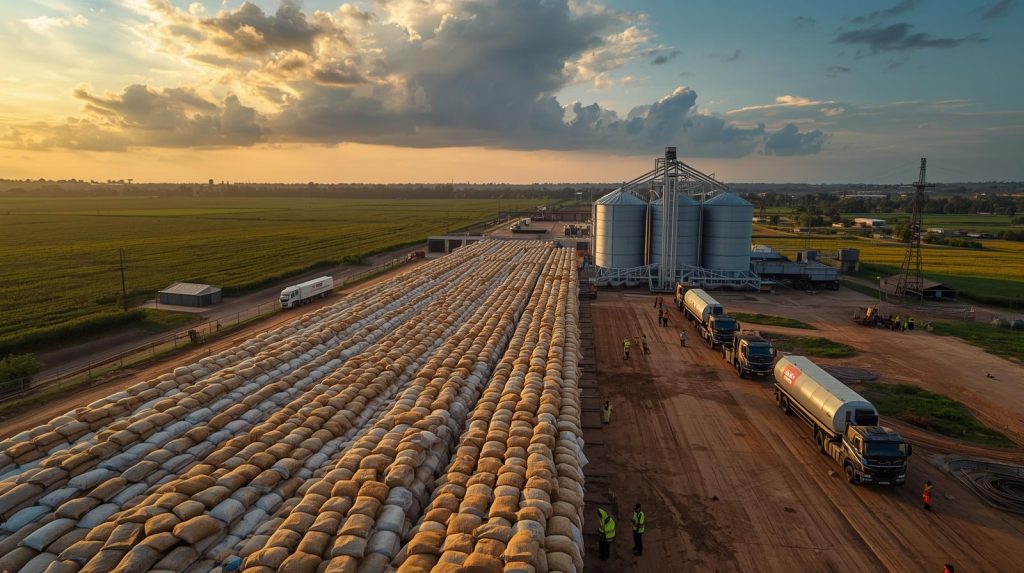
Effective commodity trading requires more than capital—it demands logistical capability. H.M. Agrovert’s integrated business model, combining trading with transportation and storage infrastructure, provides competitive advantages in aggregating and moving grain.
The company’s construction division has also contributed to developing storage facilities, addressing one of the perennial challenges in Zambian agriculture: post-harvest losses due to inadequate storage. With proper facilities, grain can be stored strategically, allowing farmers and traders to avoid distress sales at harvest when prices are typically lowest.
Farmer Advisory: Adding Value Beyond the Transaction
H.M. Agrovert’s commitment to farmers extends beyond purchasing their produce. The company’s farm advisory services provide technical support on agronomic practices, helping farmers improve yields and grain quality—factors that directly influence marketability and price.
This holistic approach recognizes that sustainable grain trading requires a healthy farming sector. By investing in farmer capacity, H.M. Agrovert is essentially investing in its own supply chain resilience.
Looking Ahead: The 2026 Season and Beyond
As Zambia moves through the 2025/2026 marketing year, the agricultural outlook remains positive. The FAO notes that the strong production recovery has reduced import needs and positioned Zambia for average to above-average maize exports, despite subdued regional demand due to widespread production recovery across Southern Africa .
For H.M. Agrovert, the focus remains on deepening relationships with farming communities while expanding market reach. The company’s projected annual turnover of ZMW 20 million reflects confidence in continued growth across all business units, with commodity trading representing an increasingly significant share.
“Zambia has the potential to be the breadbasket of Southern Africa,” Mulikita observes. “But realizing that potential requires partnerships—between government and private sector, between traders and farmers, between Zambian companies and regional buyers. That’s the kind of growth we’re building at H.M. Agrovert.”
Conclusion
In the complex ecosystem of Zambian agriculture, private grain traders like H.M. Agrovert perform an essential function: converting harvests into income, connecting surplus areas with deficit markets, and contributing to the strategic grain reserves that underpin national food security.
As the nation celebrates its agricultural recovery and looks toward export markets, indigenous companies with deep community roots and operational capability are well-positioned to drive inclusive growth. H.M. Agrovert’s commodity trading operations—grounded in a decade of experience and guided by the philosophy of “Growth Through Partnerships”—exemplify how private enterprise can advance both commercial objectives and public goods like food security.
For the farmers of Central Province, that means one thing: when harvest comes, there’s a reliable partner ready to buy.
About H.M. Agrovert General Dealers Services & Limited
H.M. Agrovert is a wholly Zambian-owned company established in 2013, providing services in agricultural inputs and outputs, mechanization, general supplies, solar products, transportation, and construction. With headquarters in Mkushi and outlets across Central Province, the company is registered with the National Pension Scheme Authority (NAPSA) and Workers’ Compensation Fund, employing over 15 permanent staff from local communities. For more information, visit www.myhmagro.com or email info@myhmagro.com.
Media Contact:
Marketing Officer
H.M. Agrovert General Dealers Services & Limited
Plot 504, Natwange Complex, Mkushi, Zambia
Email: info@myhmagro.com
Phone: +260 977 636895 | +260 966 636895
Website: www.myhmagro.com
“Growth Through Partnerships”

Leave a Reply